Overview
Edusogno's students reached support through Intercom, and its AI agent answered the routine questions. We replaced it with Edusogno Support, our own platform: a self-hosted, rebranded fork of the open-source Chatwoot for the inbox, with everything else built in-house on our Laravel API.
The Claude assistant
When a student starts a conversation, a bot flow can hand it to the resolver:
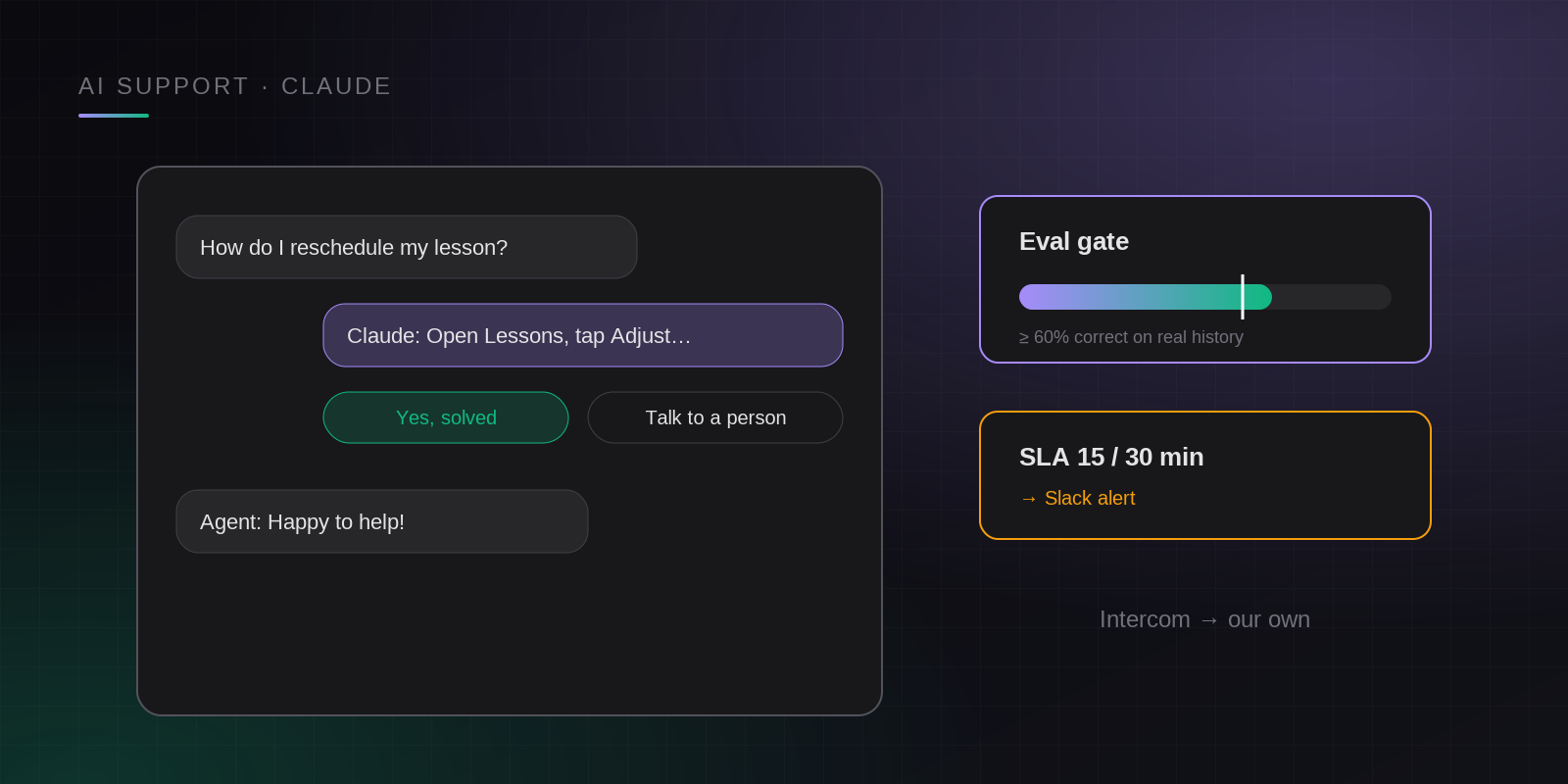
- One read-only call to Claude. The model gets the student's question, a student card without contact details, and reviewed knowledge, and returns a JSON answer with a confidence score.
- Only confident answers post. Below the threshold, or on any error, the conversation goes straight to a person.
- Every answer asks. Each reply ends with "Yes, solved / No, talk to a person", and the outcome is recorded. Answers nobody rates are settled after seven days.
- Usage is tracked in the same AI-usage log as the platform's other AI features.
Proving it before switching it on
The rollout rule was simple: the assistant stays off until it answers at least 60% of a graded sample of real questions correctly.
I built support:ai-eval to measure that. It picks past conversations a student opened and a person answered, asks the resolver the student's opening message through the same code path as a live answer (nothing is posted), and writes a sheet with the human answer next to the AI's. After a person grades the sheet, the tool reads it back and prints PASS or FAIL on the gate.
An SLA engine we didn't have to buy
Chatwoot's SLA management is an Enterprise feature, and it isn't in our fork. So support:sla-check runs every five minutes using timestamps the webhook handlers already keep:
- A human-owned conversation where the student wrote last is flagged after 15 minutes (first response) or 30 minutes (next response).
- A breach adds an
sla-breachedlabel and posts one Slack warning with deep links. The next agent reply clears it. - Office hours gate the alerts only, so the first run of the morning lists everything that waited overnight.
Moving off Intercom without losing anything
- History export.
support:export-intercompulls every conversation, contact, message, note, tag, rating, and attachment, plus the Help Center articles, into files. It has a resumable state file and retries failures. The first version managed about four conversations a minute, so I pooled requests in parallel batches; a failed request is retried on its own so one bad record never sinks a batch. - Side by side. A public
/support/bootstrapendpoint tells every app which chat to open (Intercom, both, or in-house), so the switch is a flag. The rollout runbook plans a two-week dual run before Intercom is switched off, with a rollback path. - Mobile. I wrote the hand-off spec for the app team to move from Intercom's native SDK to the in-house widget.
Bots and reliability
- n8n rescheduling bot. The bot team's rescheduling bot used Intercom's webhooks. It now gets signed, retried webhooks from Edusogno Support and replies through service-token endpoints. If it never answers, the student goes to a person.
- Races, handled. Chatwoot fires "conversation created" and the first message within the same second, and both handlers tried to create the same link row. The loser now catches the unique-constraint violation and updates the winner's row.
- No silent pending. A student writing into a resolved conversation reopens it as pending for the bot. If the bot can't take it, the conversation is opened for agents instead of sitting unseen.